
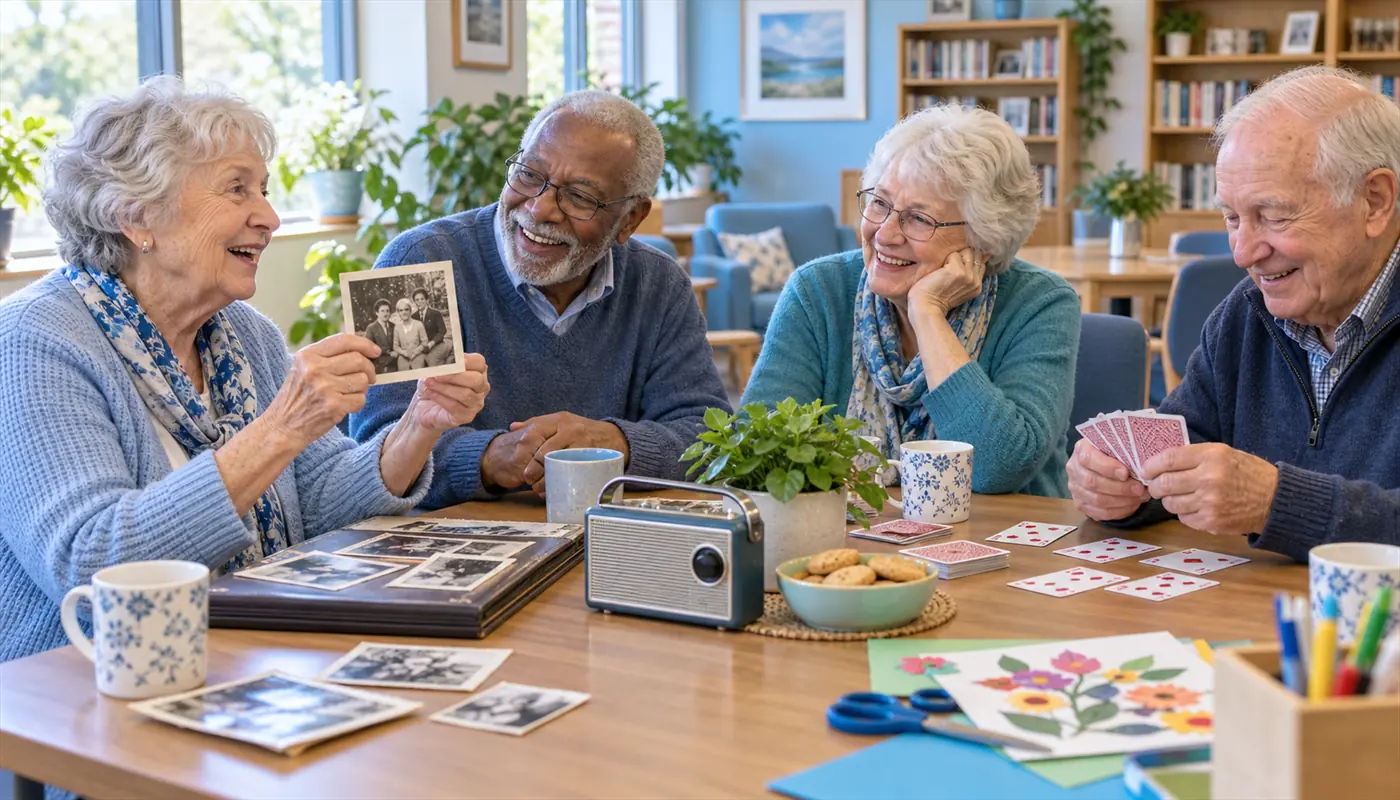
Highlights
- The best brain exercises for seniors feel less like homework and more like a satisfying part of life.
- No single puzzle trains every ability.
- Choose a decade, home, job, trip, celebration, or family tradition.
- Use photographs or objects as prompts, then tell the story to a friend or family member.
The best brain exercises for seniors feel less like homework and more like a satisfying part of life. They invite curiosity, creativity, conversation, movement, and memory while respecting the knowledge and interests built over decades.
No single puzzle trains every ability. Variety is the advantage. Rotate these five activities so the mind works with stories, sounds, patterns, skills, and social connection.
1 Create a life-story map
Choose a decade, home, job, trip, celebration, or family tradition. Write the main event in the center of a page, then branch outward with people, places, sounds, foods, clothing, and memorable details.
Use photographs or objects as prompts, then tell the story to a friend or family member. Storytelling combines autobiographical memory, sequencing, language, emotion, and social engagement. Record the finished story in writing or audio so it can be enjoyed again.
Keep the activity upbeat by selecting experiences you enjoy revisiting. A different story each week can gradually create a meaningful personal collection.
2 Build a musical memory session
Choose songs from different periods of your life. Listen to one and recall the artist, where you first heard it, people connected with it, or the next lyric without looking it up. Clap the rhythm, move to the music, or describe the instruments you notice.
Then explore one unfamiliar song and identify what makes it different. Familiar music invites recall, while new music adds novelty and close listening.
3 Play a changing card game
Use a standard deck for matching, sorting, sequencing, or familiar games. Sort by suit as quickly and accurately as comfortable. Turn cards facedown for a memory-matching game, or create a rule in which red and black cards require different responses.
Change the rule after a few rounds. That variation asks the brain to remember instructions, notice patterns, and adjust. Playing with another person adds conversation, turn-taking, and friendly competition.
4 Learn one practical new skill
Choose something useful and interesting: smartphone photography, a recipe, a garden technique, a few phrases in another language, a craft, a dance step, or a feature on a digital device.
Divide the skill into small lessons. Practice, pause, and explain the steps from memory. The National Institute on Aging notes that meaningful, cognitively demanding activities show promise for supporting cognitive health and well-being.
Progress matters more than mastery. Every new step gives you something to anticipate and share.
5 Start a conversation challenge
Meet or call a friend and choose a theme: favorite travel memories, inventions that changed daily life, books, local history, or plans for the coming month. Take turns asking follow-up questions and recalling details from earlier in the conversation.
At the end, each person summarizes one thing learned about the other. Conversation naturally exercises listening, language, memory, interpretation, and response. It also supports connection and belonging.
Make brain exercise a whole-body experience
Pair these activities with movement whenever possible. Walk while discussing a theme, learn a dance, garden with a neighbor, or photograph a new route. Physical activity, social connection, and mental engagement can work together in one enjoyable event.
Support participation with good lighting, comfortable seating, clear sound, and any prescribed hearing or vision aids. The easier it is to see, hear, and engage, the richer the mental experience can become.
Choose one exercise for this week and place it on the calendar. Keep it enjoyable, adjust the difficulty, and celebrate the pleasure of learning. A curious life offers the brain fresh material at every age.
Ask family members to contribute photographs, songs, questions, or activity ideas. Their participation can create fresh prompts while turning brain exercise into valued time together.
Sources and Further Reading
This article provides general educational information and is not medical advice. A qualified healthcare professional can help you evaluate choices in relation to your health history, medications, and individual needs.