
Highlights
- Memory improves through good strategies as well as repetition.
- Use these five exercises for ten to fifteen minutes several times a week.
- Choose five to ten items: groceries, names, cities, plants, or objects in a room.
- The important step is retrieval.
Memory improves through good strategies as well as repetition. The most useful brain exercises invite you to pay attention, organize information, retrieve it, and connect it with something meaningful. You can practice all four skills at home without an app, workbook, or special equipment.
Use these five exercises for ten to fifteen minutes several times a week. Keep the challenge comfortable and change the material as you improve.
1 The active-recall list
Choose five to ten items: groceries, names, cities, plants, or objects in a room. Read the list once, put it away, and write down everything you remember. Check your results, wait several minutes, and recall the list again.
The important step is retrieval. Rereading can create familiarity, while recalling asks the memory to produce the information. Make the exercise more engaging by grouping items into categories or forming a vivid image that includes several of them.
Use real life, too. Before entering the store, recall your shopping list and use the written version only to check your work.
2 The story chain
Take five unrelated words—perhaps bicycle, orange, clock, river, and hat—and connect them in one exaggerated story. Imagine riding a bicycle made from an orange, passing a giant clock, crossing a sparkling river, and discovering a hat on the other side.
Unusual images are memorable because they create connections. Once five words feel easy, try seven or ten. Tell the story aloud to add language and sound.
3 The memory walk
Picture a familiar route through your home. Choose five locations in a fixed order: front door, sofa, dining table, sink, and bed. Place one item you want to remember at each location using a lively mental image.
To recall the items, mentally walk the route. This method, often called a memory palace, uses spatial knowledge you already possess as an organizing system. Add locations gradually and keep the route consistent.
4 The observation snapshot
Study a photograph, shelf, garden view, or tabletop for 30 seconds. Notice positions, colors, shapes, and relationships. Turn away and write or say every detail you can recall. Look again and celebrate what you noticed.
Repeat with a new scene, or ask a partner to move one object and identify the change. This exercise makes attention deliberate, and attention gives memories stronger material to work with.
5 The two-minute teach-back
Read a short article, watch an educational video, or learn one new fact. Close the source and explain the idea in your own words as if teaching a friend. Include the main point, two supporting details, and one example.
Teach-back combines understanding, organization, and retrieval. If the explanation feels incomplete, review the source and try again. The second attempt is part of learning, not a score.
Create a balanced memory routine
Rotate the exercises instead of repeating only your favorite. Variety invites the brain to work with words, images, locations, details, and ideas. Increase difficulty slowly by adding one item, waiting longer before recall, or using more complex material.
Support practice with sleep, movement, nourishing meals, hearing and vision care, and social interaction. These habits help create the conditions in which learning can happen.
Use external memory tools confidently as well. Calendars, lists, reminders, and consistent locations for keys or glasses preserve attention for higher-value thinking. Strategy and training work well together.
Choose one exercise today and repeat it three times this week. Track improvement in detail, confidence, or speed. The goal is not flawless recall; it is an active, curious mind that keeps practicing useful ways to remember.
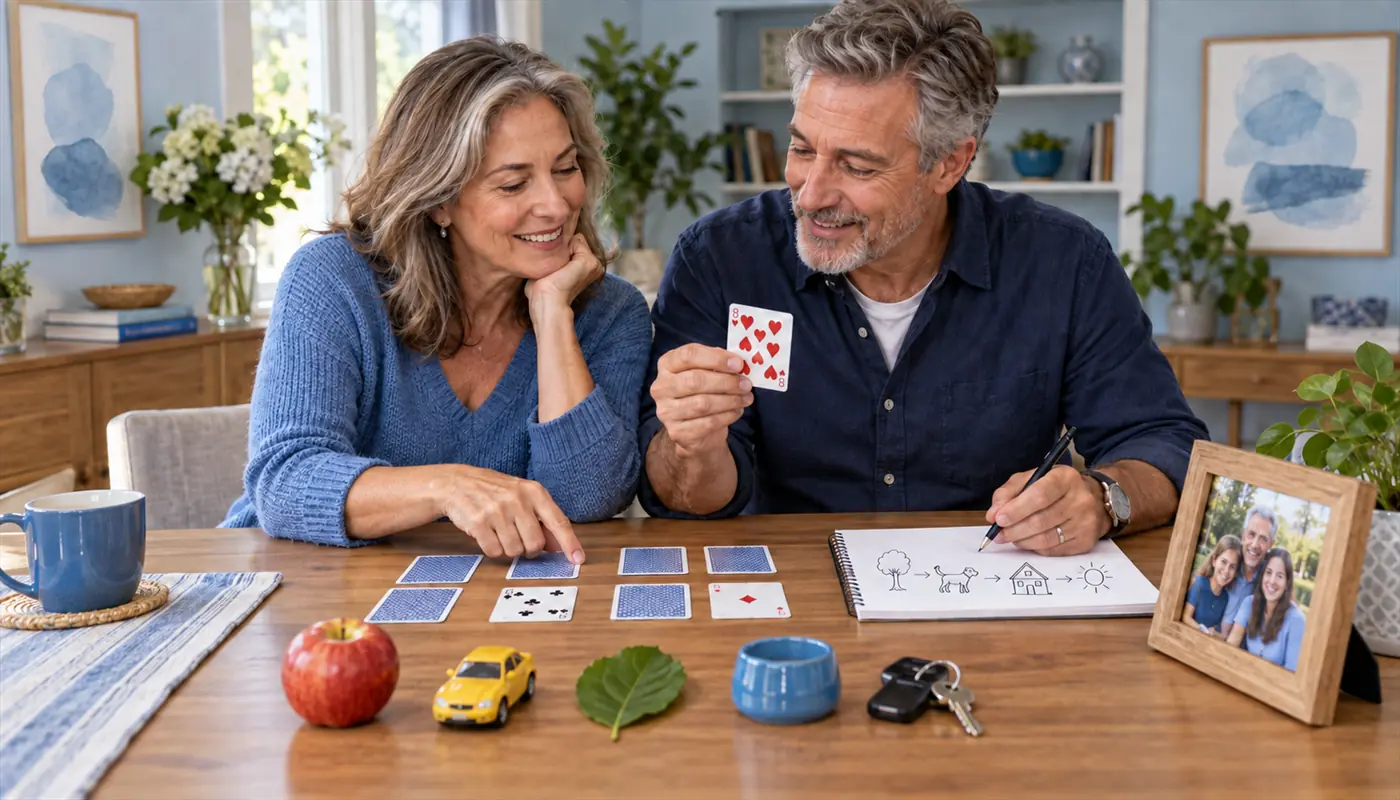
Invite a friend or partner to try one exercise with you. Comparing stories, details, and strategies adds social connection and makes practice feel like shared discovery.
Sources and Further Reading
This article provides general educational information and is not medical advice. A qualified healthcare professional can help you evaluate choices in relation to your health history, medications, and individual needs.